Author: Stonehunter

cleaning and sealing natural stone

Stone Sealer Products Benefit for Many Years 

Stone Cleaning and Sealing Tips for Natural Stone Pavers, Tile, Coping, and Step Treads. 

Hardwood decks/patios, as well as wood on houses/buildings, need to be power washed, cleaned, and sealed on a regular basis.   Although you power wash and seal a hardwood deck every year, natural stone deck maintenance is much less frequent.  Stone sealer and cleaner products are very high-tech and require minimal maintenance.

Stone Cleaner Maintenance for Natural Stone Pavers, Tile, Coping or Treads:

  1. Regular, basic maintenance type cleaning: *
    • Use a stone cleaner that is easy to find at any hardware store or
    • Use any non-caustic degreasing agent (mild dish or hand soap) mixed in warm water.
  2. Deep cleaning, minor restoration (mild etch) type cleaning:
    • Dilute muriatic acid in ten-part water to 1-part store-bought muriatic acid.
    • Wet the entire stone surface.
    • Pour dilute mix and move it around with a sponge mop – consider doing it in twenty square feet overlapping sections.  Don’t let it sit in one place without moving and agitating it.  The acid will neutralize after 10-15 seconds.
    • Finish by rinsing the surface with clean water.

Note: The acid should not be strong enough to do any damage to the ecology or be harmful to your flower beds next to the stone patio. Once the acid contacts the stone, there is a little bit of sizzle, a bit of chemical reaction that happens and then it should be neutralized.

Stone Sealer Maintenance for Natural Stone Pavers, Tile, Coping or Treads: **

With natural stone, you should never use a prophylactic coating type of sealer because the stone wants to breathe.  Using a “breathable” stone sealer tends to last many years longer.  When using a high-quality sealer, you will only have to seal every 5-15 years or longer.  Some companies offer both a color-enhancing stone sealer and a “matte” finish stone sealer. Both types of sealers are impregnating sealers and penetrate the stone about a ¼”.  The color-enhancing stone sealer will help the stone “pop” its deep rich darker color (like when it is wet but doesn’t add shine or sheen to the stone). The “matte” finish stone sealer leaves the stone the same color when it is dry. Gothicstone recommends Stain Proof, stone cleaner, and stone sealer products.   

Considerations when applying stone sealer:

  1. If grout was newly applied to the tile, pavers, coping, or treads, you should wait at least 2 weeks for the outgassing to complete before using a stone sealer.
  2. If only stone cleaning was done, seal after the stone is thoroughly dry, typically a day or two. 
  3. Follow the directions on the bottle for the impregnating sealer.

 * This does not apply to highly polished marble – contact us for those details.

** We highly recommend purchasing sealer products from a tile showroom.  We recommend Stain Proof by Dry-Treat.

Are you looking for different exterior stone options? Gothicstone is here to help.  Contact us today to find out more about our products so we can value-engineer your stone solution. We look forward to providing you with natural stone materials to help make your client’s outdoor living space unique.

Paver and Tile Installation and Maintenance Frequently Asked Questions

Tips: Gothicstone Travertine, Limestone or Marble Paver Installation

Techniques:

Installation Considerations – Dry Set:

  • The use of spacers is not necessary particularly when dry setting these pavers.
  • No sealing or maintenance is required. Natural rain will flush and clean the stone.
  • Same installation methods and considerations, like other decorative pavers, should be employed including using a pad on your vibrating plate.
  • See our blog posts for specific considerations ie:  Battling Mother Nature, Part I, mold/algae problems, https://www.gothicstone.com/how-to-battle-mother-nature-part-i/

Continue reading

Pedestal pavers expand their exterior footprint

Pedestal pavers have been used for decades now, most familiarly for lightweight rooftop applications such as installing a patio utilizing the existing roof substrate.  Additionally, they are commonly used in computer rooms where access to electrical and telecommunication cables beneath the floor is necessary.

How pedestal paver systems work

Basically, a pedestal, typically made of plastic, raises up the four corners of a paver off the ground with small spacers in each corner. This leaves a small spacer (or tiny little gaps) on each side of the paver or tile, allowing the floor to breathe or, outdoors, for drainage and access.  Other benefits, discussed in detail below, are time savings for installation, accessibility for future changes, retrofitting, and MEP (Mechanical, Electrical, and Plumbing) requirements.

Requirements for pedestal pavers

It is recommended that you have a flat plane (not necessarily level, but flat) substrate on which to install the pedestal paver system.

  • Outdoors, a concrete substrate is optimal.
  • Rooftop, it should have a slight slope and have decent rainwater drainage.  You can now put tables and chairs on an even tile or paver surface since the pedestal’s underneath are adjusted to allow for the slope, taking away the rainwater underneath, and creating a flat surface on top.  The most important consideration is that you have a stable base or substrate.  
  • A limitation to be considered (and conversely; a benefit of using LARGE FORMAT PAVERS) is that the use of smaller pavers negatively impacts the efficiencies in both installation time and budget (the quantity of pedestals required could increase five-fold, or more).

Why should you consider pedestal pavers?

There are many economic benefits with the application of pedestal paver systems, not to mention the green and sustainable considerations i.e. carbon footprint.

  • In a dry-set installation, you use much less gravel, and often much less excavation, and no need to dispose of excavated soil!
  • In a “wet-set installation”, the benefit is that it can’t fail due to cracks in the substrate. You may have a paver or tile fail but if you have a solid substrate underneath, your broken piece can be easily replaced in a matter of minutes.  It’s a floating system, much like a dry-set installation; the pavers/tiles are not physically locked into the substrate.
  • Pedestals are a good application for retrofitting. If you can afford a little added height, it’s quick and easy and saves you lots of money on installation. You only need to methodically place your pedestals on your flat substrate and insert the pavers; a small patio can be done in time for “dinner al fresco” later that same day!

The Perfect Application

A perfect, “save the day” pedestal paver application would be an old, ugly concrete patio, which is degraded somewhat, some cracking here and there but basically in decent shape. You can make it new by laying pedestals over the concrete, placing your pavers or tiles on top. 

  • With a crew of three or four laborers, you could probably install several thousand square feet in one day. 
  • Pedestals work well (and very cost-effectively) if you use larger format tile or paver sizes such as 12”x12”, 16”x16” or up to and, including 24”x24”. 
  • Caution: you must use the correct material/product because it must be strong (appropriate flexural strength) otherwise the corners may break since there is no support in the center of the paver or tile.  See Gothicstone material recommendations.

New uses and benefits of pedestal pavers!

One of the big benefits of a pedestal system is the accessibility for future changes that may be desired.

Once installed, you can lift those large format pavers or paver tiles and have access to the MEP (mechanical, electrical, plumbing) underneath it, whether you want to put in water lines for a new outdoor kitchen, gas lines for outdoor fire pit, stereo speaker wire, or electrical cables.

You can do all that just by lifting the necessary paver tiles/pavers and then laying the cables/pipe (etc.) and then replacing them on the pedestals.  Realizing a huge economy in time and expense and underscoring why they are commonly used in modern computer data centers. 

Green attributes – these installations use a lot less gravel compared to what may be five truckloads of gravel used in a typical backyard patio paver outdoor living environment.  This method is a lot less expensive and eliminates a big dent in the carbon footprint.

Ability to make changes later….

If a tile or paver piece breaks, gets stained or other reasons arise for making a change, or let’s say, you want to add an outdoor kitchen someday or enlarge the patio, you can easily move and interchange pieces by just lifting them up and replacing them. 

Let’s say you add a firepit area somewhere, about 100 sq. ft. and you get a new lot of stone in from the same quarry, that’s lighter or darker than the old lot.  With a pedestal system, you can blend the old pieces with the new.

So, you would take the bulk of the new lot, and pull up the equivalent amount in the old deck, mixing the two. For instance, if you have 25 pieces for the new lot, you will take 20 of those new pieces and randomly pull up 20 pieces from your existing (old) deck.  Take those 20 old pieces and put them aside.  Put the new pieces, randomly, into those spots where you pulled those pieces out to blend in a little bit.  Then you take the old pieces and mix them with the 5 new pieces in the new area and now your stone will match throughout. 

Quick and easy installation – have a concrete slab poured for a new installation and just use the pedestals.  It doesn’t matter if your new concrete slab develops small cracks after a few years (which almost all concrete slabs eventually do), your pedestals will keep it at the same level plane.

Want more on this topic, contact us for a free consultation about your project!

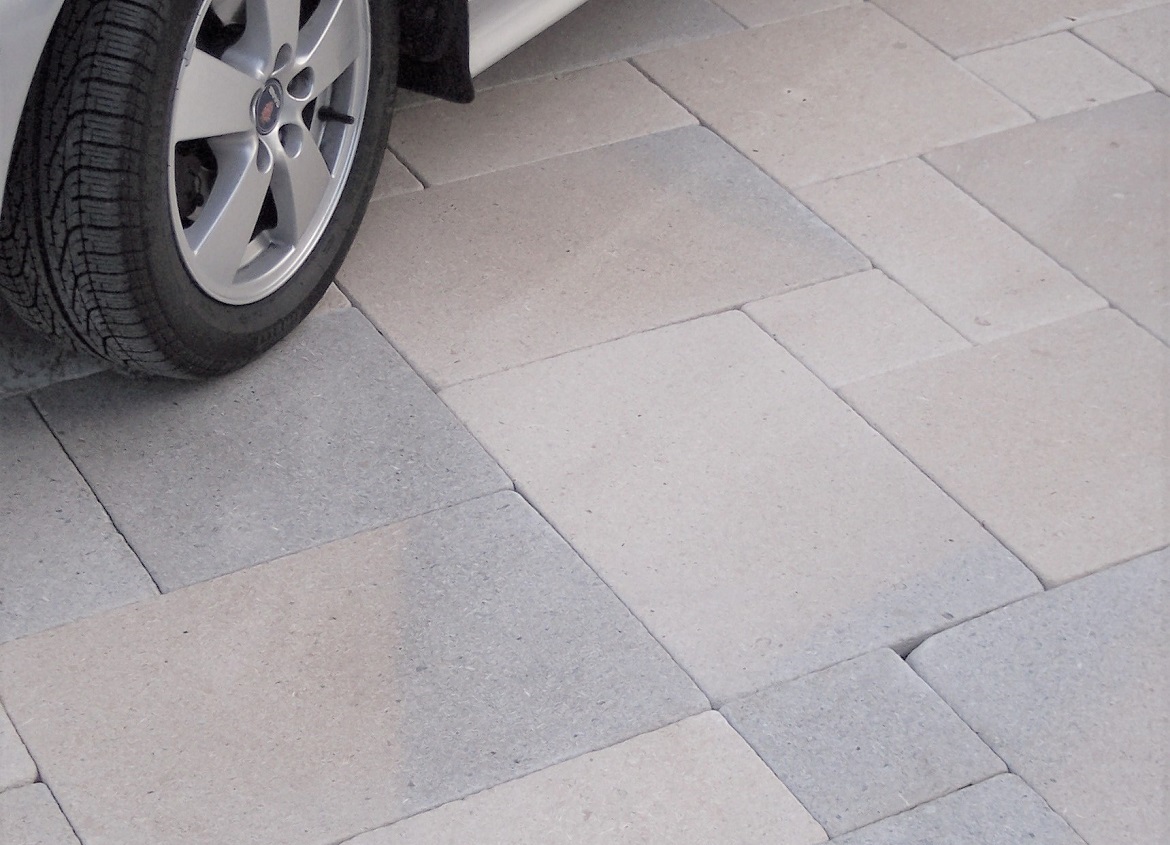
Considerations for Specifying Natural Stone in Driveway Paving Applications.

Natural stone driveways are beautiful, durable, strong and will survive the test of time!

One of our prospective clients asked us about the ability to use natural stone driveway paving ie: travertine, limestone, sandstone, or marble for re-designing a commercial and pedestrian plaza area.

Project situation

  • There will be commercial trucks and cars driving on the plaza. 
  • The driveway pavers need to be 2 ¼” thickness.
  • Along the plaza are pedestrian walkways for people to stroll and walk througout the plaza.

Response for project considerations

  • Gothicstone can produce pavers at 2 1/4″ thick, 3″, 4″, 5″, 6″ or any thickness desired.  
  • Secondly, the concern of the ability to handle truck traffic on natural stone driveway paving projects is not necessarily the thickness of the pavers. The issue is the surface dimension of the driveway pavers. The larger surface area makes the paver more likely to be negatively impacted by a large void (or conversely a fulcrum point) below it. Of course these pitfalls can be avoided with appropriate attention to proper installation methods, techniques, and technologies.
  • Consequently, a smaller format paver (as in 3″x3″ or 4″X4″ surface) would be highly unlikely to ever crack or fail.
  • That being said, SEAHAZEtm SEA limestone pavers are extremely durable, when installed correctly, can withstand any vehicular traffic that they need to endure. 

Below are questions for consideration before specifying driveway paving natural stone for your project.

1. What driveway paver size(s) are you considering?

A shift to large format natural stone for both residential and commercial driveway systems is gaining popularity.  Natural stone in all formats–traditional (small 4”x4”, 6”x6” cubes or random length) or the larger formats (which are gaining traction with architects and designers–with its aesthetic and structural benefits), makes it a strong alternative to concrete pavers. 

2. What color scheme are you considering?  

  • Warm or cooler tones?
  • Is there flexibility in the design pertaining to color?

3. What format or patterns are you considering for the design of the driveway pavers?

4. What surface treatment or finish are you considering ie: bush hammer, sandblasted, honed, tumbled? https://www.gothicstone.com/materials/surface-finishes/

5. Would the surface finish be the same for both walkways and vehicular traffic?

6. What thickness are you considering for the driveway pavers?

7. What other architectural considerations do you require?

  • Curbs
  • Step treads
  • Other decorative pieces?

8. What installation method do you prefer to utilize for each of the areas?

9. What is the proposed quantity for the project?

  • Vehicular traffic areas (indicate thickness)
  • Walkway areas (indicate thickness – no need to use 2 ¼” for pedestrian traffic)

10. What is the desired delivery date for the project materials?

11. What is your budget for the natural stone materials per square foot?

Are you looking for different exterior stone options? Gothicstone is here to help.  Contact us  today to find out more about our products so we can value-engineer your stone solution. We look forward to providing you with natural stone materials to help make your client’s outdoor spaces unique.

Gothicstone Consulting Services

We have recommended over the years Cell-Tek Geosynthetics, LLC stabilization grid systems.